Legendary Warriors
Introducing…
The Legendary Warriors Series
About the Legendary Warriors
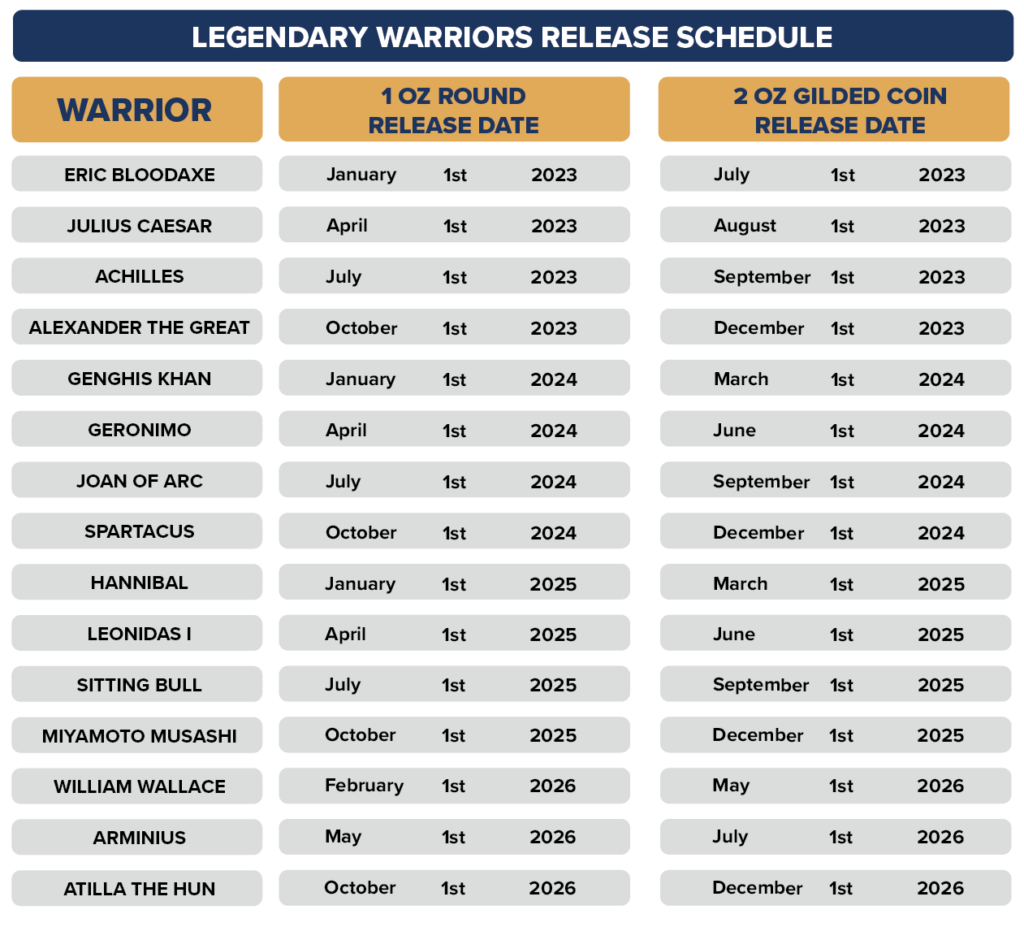
Inspired by a love of history and myths, the Legendary Warriors series showcases historical and legendary figures who inspired and often terrified many with their strength, cunning, and ambition. These .999 silver rounds are available in 1 oz and 2 oz high relief. The series includes Julius Caesar, Achilles, Alexander The Great, Spartacus, William Wallace, Geronimo, Sitting Bull, Joan of Arc, Genghis Khan, Leonidas I, Miyamoto Musashi, Arminius, Attila The Hun, and Hannibal. This Eric Bloodaxe round is the first reveal of the series celebrating the most famous warriors from history and legend. The Legendary Warriors series can be purchased directly from Pinehurst Coins on this page.
Table of Contents
Eric Bloodaxe

Eric Haraldsson, otherwise known as Bloodaxe, is one of the most famous Vikings. He is most known for being a warrior and king of Norway who gained his throne through the gradual extermination of all of his brothers. However, his history often needs clarification between myth and legend. Historians have gathered that he was a brutal, oppressive, and unpopular brief ruler of Norway and Northumbria (modern-day north England).
When Haraldsson’s father died, he killed his half-brothers to gain complete control of Norway. One legend recounts that his surviving younger brother, Hakon, challenged him for control of the kingdom, which Haraldsson gave it up without a fight. Later, he was banished from Norway and traveled to Northumbria, where he led bloody raids upon Scotland. Additional legends indicate he invaded Northumbria and forced his way into kingship. Still others state he was made a sub-king by King Athelstan, a friend of his father, and ruled from 947-948 and 952-954 A.D.
Limited Edition Gilded High Relief
The Eric Bloodaxe $5 coin is available in a Limited Edition Gilded High Relief 2 oz .999 fine silver with gold-toned highlights.
*Limited Mintage of 500

Julius Caesar

Julius Caesar, the second release in the Legendary Warrior series, was renowned as a general, statesman, and dictator. Caesar’s intellect and insatiable appetite for warfare were responsible for the transition of Rome from a Republic into an Empire and for his assassination in 44 B.C. His documentation of the Gallic and Civil Wars earned him an additional accolade as a historian.
As head of the government, Caesar formulated social, land, and governmental reforms, including the creation of the Julian calendar. During his reign, Caesar also centralized the bureaucracy of the Republic. Today, his political philosophy, Caesarism, still inspires individuals.
In all, Julius Caesar symbolizes power, ambition, and leadership.
Limited Edition Gilded High Relief
With its gold-toned highlights, the Julius Caesar $5 coin is available in a Limited Edition Gilded High Relief 2 oz .999 fine silver.
*Limited Mintage of 500

Achilles

Achilles, the third release in the Legendary Warrior series, was a Greek warrior, is best known for his pivotal role in the Trojan War, as recounted in Homer’s “Iliad.”
Renowned for his near invincibility, Achilles’ only weakness was his heel, leading to the term “Achilles’ heel.”
His mother, Thetis, dipped him in the River Styx as a child, rendering him invulnerable except for the heel by which she held him. Achilles’ fierce combat skills and leadership were instrumental in numerous Greek victories, but his rage following the death of his close friend Patroclus drove much of his narrative. Ultimately, he was fatally wounded by Paris, who struck his vulnerable heel with an arrow.
Limited Edition Gilded High Relief
With its gold-toned highlights, the Achilles $5 coin is available in a Limited Edition Gilded High Relief 2 oz .999 fine silver.
*Limited Mintage of 500

Alexander The Great

Alexander the Great, the fourth release in the Legendary Warrior series, was born in 356 BCE, and became king of Macedonia at age 20, and swiftly embarked on an ambitious military campaign. His most notable victory came at the Battle of Gaugamela in 331 BCE, where he decisively defeated the Persian King Darius III, leading to the fall of the Achaemenid Empire.
Alexander’s military prowess extended through his tactical genius at battles such as Issus and Hydaspes, which showcased his innovative use of the phalanx and cavalry. By his death in 323 BCE, Alexander had created one of the largest empires in history, stretching from Greece to Egypt and into northwest India. His legacy endured through the Hellenistic period, profoundly influencing military strategies and cultural exchanges across these regions.
Limited Edition Gilded High Relief
With its gold-toned highlights, the Alexander The Great $5 coin is available in a Limited Edition Gilded High Relief 2 oz .999 fine silver.
*Limited Mintage of 500

Genghis Khan

Genghis Khan, the fifth release in the Legendary Warrior series, was the founder and first Great Khan of the Mongol Empire. Born as Temujin in 1162, Genghis Khan united the fragmented Mongol tribes and became their leader in 1206.
His military strategies, characterized by swift horsemen and innovative tactics, led to the rapid expansion of the Mongol Empire. Genghis Khan’s conquests stretched from China to Europe, creating the largest contiguous empire in history. He employed psychological warfare and espionage to outmaneuver his enemies, fostering loyalty and discipline within his ranks. By his death in 1227, Genghis Khan had laid the foundations for an empire that reshaped global history and trade.
Limited Edition Gilded High Relief
With its gold-toned highlights, the Genghis Khan $5 coin is available in a Limited Edition Gilded High Relief 2 oz .999 fine silver.
*Limited Mintage of 500

Geronimo

Geronimo, the sixth release in the Legendary Warrior series, was the Bedonkohe Apache leader, who was renowned for resisting Mexican and U.S. expansion into Apache tribal lands in the American Southwest during the 19th century.
Geronimo’s ability to elude capture for many years earned him a legendary reputation. In 1886, after a prolonged pursuit, he surrendered to U.S. authorities, marking the end of armed resistance for the Apache people. He spent the remainder of his life as a prisoner of war, becoming a symbol of Native American resistance and the struggle for cultural preservation.
Limited Edition Gilded High Relief
With its gold-toned highlights, the Geronimo $5 coin is available in a Limited Edition Gilded High Relief 2 oz .999 fine silver.
*Limited Mintage of 500

Joan of Arc

Joan of Arc, the seventh release in the Legendary Warrior series, was a peasant girl from Domrémy, France. She claimed to have received divine visions instructing her to support Charles VII and recover France from English domination late in the Hundred Years’ War.
In 1429, she convinced Charles VII to allow her to lead a French army to the besieged city of Orléans, where her leadership and courage inspired the troops and led to a pivotal victory. Following the triumph at Orléans, Joan participated in several other successful military campaigns, significantly boosting French morale and paving the way for Charles VII’s coronation in Reims. Her presence on the battlefield, clad in armor and carrying a white banner, became a symbol of hope and resistance for the French forces. Despite her military successes, Joan was captured by the Burgundians in 1430, handed over to the English, and subsequently tried and executed for heresy in 1431.
Limited Edition Gilded High Relief
With its gold-toned highlights, the Joan of Arc $5 coin is available in a Limited Edition Gilded High Relief 2 oz .999 fine silver.
*Limited Mintage of 500

Spartacus

Spartacus, the eighth release in the Legendary Warrior series, was a Thracian gladiator who became a prominent figure in Roman history due to his role as a leader in the Third Servile War (73-71 BCE). Initially serving as an auxiliary in the Roman army, Spartacus was captured and enslaved, eventually ending up in a gladiatorial school in Capua.
In 73 BCE, he led a revolt alongside other gladiators, escaping and gathering a formidable army of fellow enslaved people and disaffected peasants. Spartacus was a strategic and charismatic leader, winning several battles against Roman forces sent to suppress the rebellion. Despite initial successes, his forces were ultimately defeated by the legions commanded by Marcus Licinius Crassus. Spartacus is believed to have died in battle in 71 BCE, and his legacy endures as a symbol of resistance against oppression.
Limited Edition Gilded High Relief
With its gold-toned highlights, the Spartacus $5 coin is available in a Limited Edition Gilded High Relief 2 oz .999 fine silver.
*Limited Mintage of 500

Hannibal
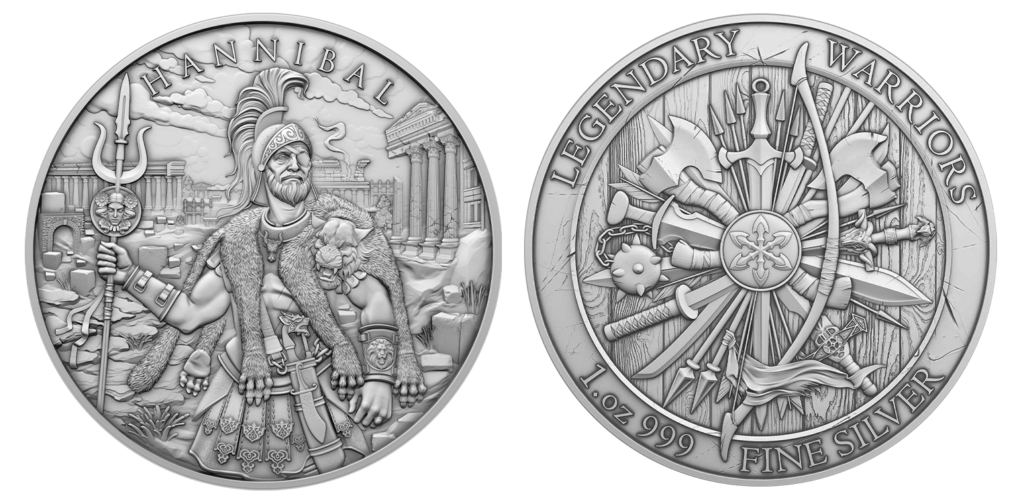
Hannibal Barca, the ninth release in the Legendary Warrior series, was a Carthaginian general renowned for his tactical genius during the Second Punic War against Rome. Born in 247 BC, Hannibal was the son of Hamilcar Barca, a prominent Carthaginian leader who instilled deep-seated animosity towards Rome.
He is most famous for his audacious crossing of the Alps in 218 BCE, leading a diverse army that included war elephants. This maneuver allowed him to surprise and decisively defeat Roman forces in several battles, including the Battle of Cannae in 216 BCE, where he inflicted one of the worst defeats in Roman history. Despite his tactical brilliance, Hannibal could not secure a long-term victory and retreated to Carthage. His final defeat came at the Battle of Zama in 202 BCE, where he faced the Roman general Scipio Africanus. After the war, Hannibal continued to influence military strategy and was later forced into exile, where he eventually took his own life to avoid capture by the Romans.
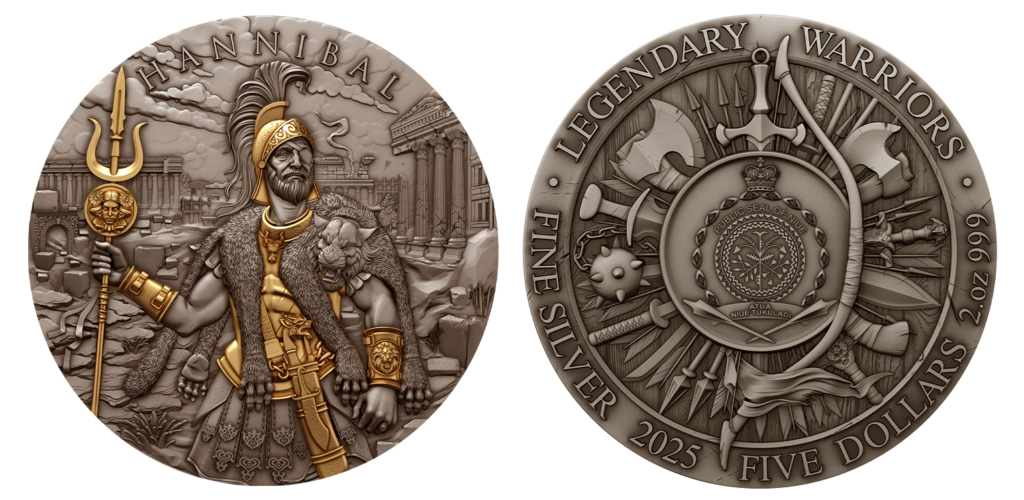
Limited Edition Gilded High Relief
With its gold-toned highlights, the Hannibal $5 coin is available in a Limited Edition Gilded High Relief 2 oz .999 fine silver.
*Limited Mintage of 500
Leonidas I
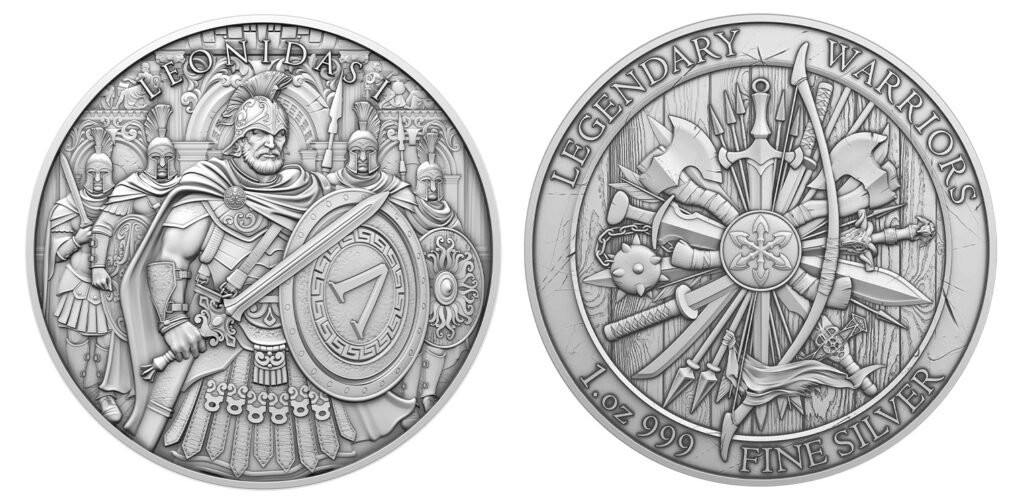
Leonidas I, the tenth release in the Legendary Warrior series, is renowned for his leadership during the Battle of Thermopylae in 480 BCE. He ascended to the throne around 490 BCE and was a member of the Agiad dynasty. Leonidas was one of the key figures in the Greek resistance against the Persian invasion led by Xerxes.
At Thermopylae, he led a small force of 300 Spartans, accompanied by several thousand allied Greek soldiers, to hold the pass against a vastly larger Persian army. Despite being heavily outnumbered, Leonidas and his men fought valiantly for three days. His decision to stay and fight to the death became a symbol of courage and sacrifice. The Spartans’ stand at Thermopylae delayed the Persian advance, giving the Greek city-states valuable time to prepare for subsequent battles. Leonidas’ heroism has been celebrated in history and popular culture, cementing his legacy as one of ancient Greece’s most outstanding military leaders.
Limited Edition Gilded High Relief
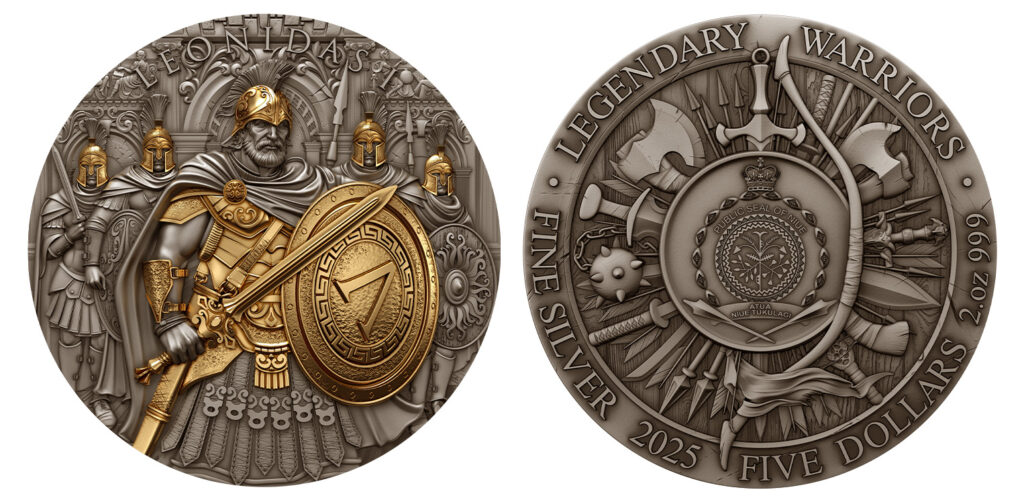
With its gold-toned highlights, the Leonidas I $5 coin is available in a Limited Edition Gilded High Relief 2 oz .999 fine silver.
*Limited Mintage of 500
Sitting Bull
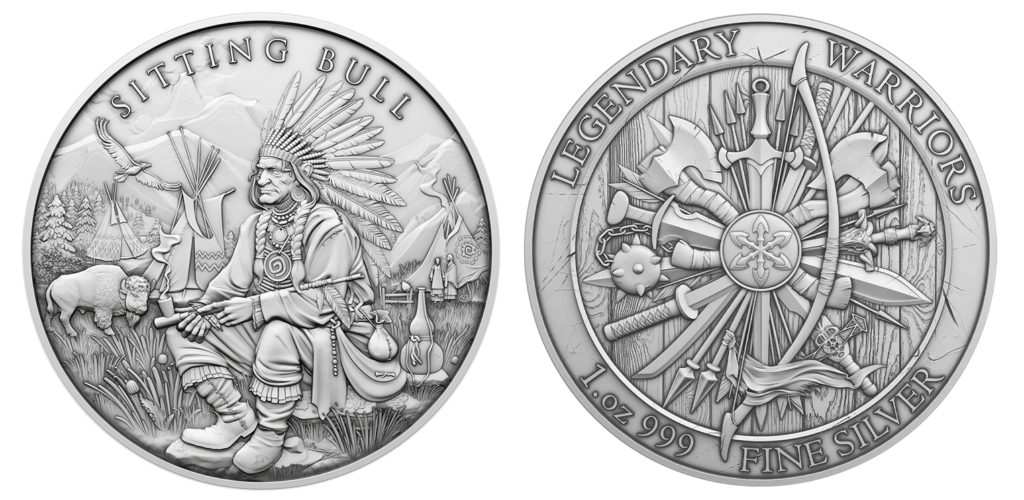
Sitting Bull, the eleventh release in the Legendary Warrior series and a prominent Hunkpapa Lakota leader, had a complex relationship with the military throughout his life. Initially, he fought against U.S. forces in battles such as the Battle of the Little Bighorn in 1876, where he played a significant role in defeating General Custer. After this victory, Sitting Bull became a symbol of resistance to American encroachment on Native American lands. In 1881, he surrendered to U.S. authorities and was confined to a reservation.
Despite surrendering, Sitting Bull remained a potent figure among his people and continued to advocate for Lakota rights. However, tensions with the U.S. government persisted, leading to his arrest in 1890. Tragically, his arrest sparked unrest among his followers, culminating in the Wounded Knee Massacre, where Sitting Bull was killed. His legacy as a fearless leader and advocate for Native American sovereignty remains deeply significant in the history of Native American resistance against colonial forces.
Limited Edition Gilded High Relief
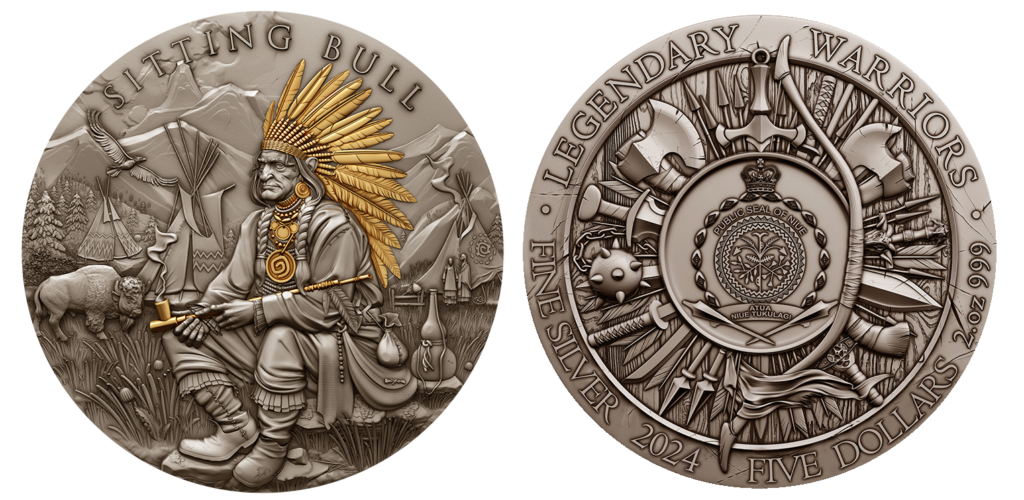
With its gold-toned highlights, the Sitting Bull $5 coin is available in a Limited Edition Gilded High Relief 2 oz .999 fine silver.
*Limited Mintage of 500
Miyamoto Musashi
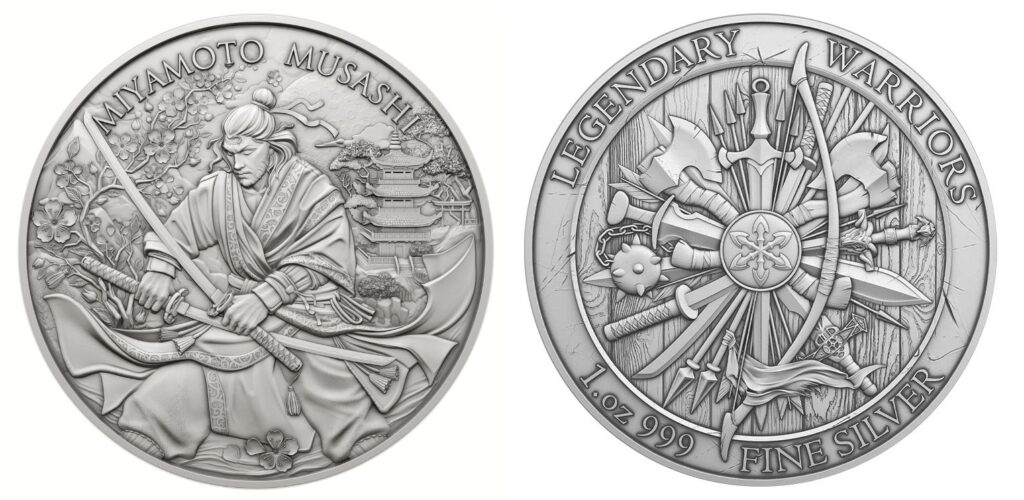
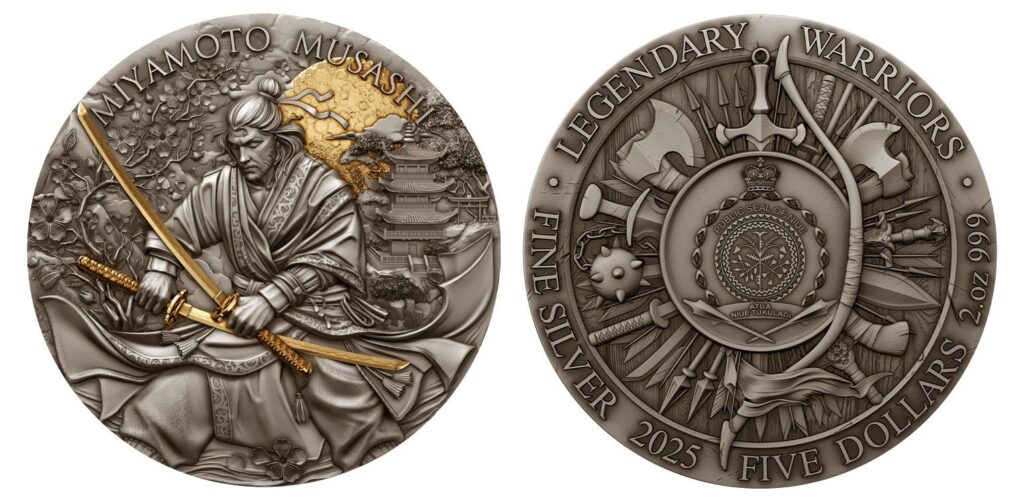
Miyamoto Musashi, the twelfth release in the Legendary Warrior series, is celebrated as one of the greatest samurai in history. Born during Japan’s turbulent Sengoku period, he became renowned for his unmatched skill with the sword and his mastery of the dual-blade fighting style known as Niten Ichi-ryū (“Two Heavens as One”). Musashi was said to have fought over sixty duels, beginning with his first victory at age thirteen, and he was never defeated.
Musashi is most famous for his treatise The Book of Five Rings (Go Rin no Sho), a classic text on strategy, tactics, and philosophy that is still studied worldwide by martial artists, military leaders, and business strategists alike. In it, he presents principles of combat and life drawn from his experiences as a warrior, emphasizing adaptability, observation, and an indomitable spirit. Beyond swordsmanship, Musashi was also a skilled painter, calligrapher, and sculptor, embodying the ideal of the samurai who sought harmony between martial ability and artistic refinement. Today, he remains a cultural icon in Japan and around the world, symbolizing discipline, resilience, and the pursuit of mastery.
Limited Edition Gilded High Relief
With its gold-toned highlights, the Miyamoto Musashi $5 coin is available in a Limited Edition Gilded High Relief 2 oz .999 fine silver.
*Limited Mintage of 500