

In the previous installments of our History Through Coins series, we followed coinage from ancient Greece and Rome through the medieval period and into the Renaissance trade networks that helped connect the world. Part 4 brings us to a period of transformation unlike any before it.
The Industrial Revolution, beginning in Britain around 1760 and eventually spreading across the Atlantic to the young United States, did more than reshape how goods were produced—it fundamentally changed how coins were made. For the first time, steam-powered machinery and industrial manufacturing techniques entered the mint, allowing coins to be produced with a level of consistency, precision, and efficiency that earlier methods could not match. The coinage of this era serves as a lasting record of that technological revolution, preserving the story of industrial progress in metal.
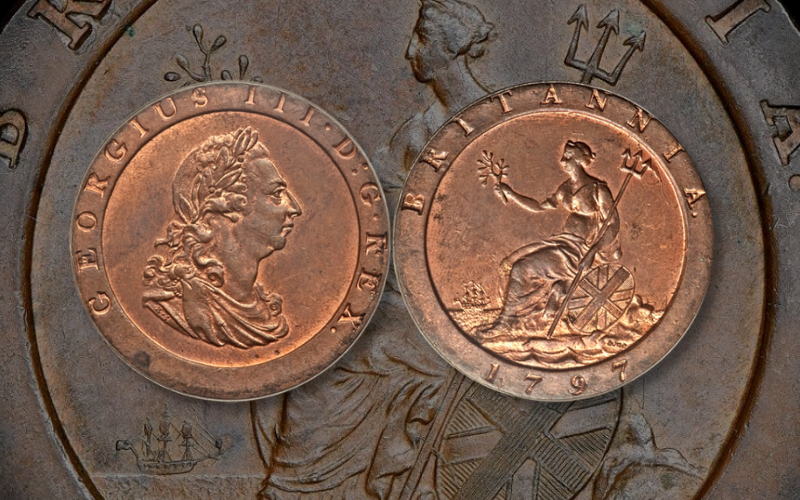
The First Modern Coins: Britain’s Cartwheel Penny and Twopence
By the late 18th century, Britain’s copper coinage was in crisis. The Royal Mint had produced little official copper coinage for decades, leaving a shortage that counterfeiters and private token issuers rushed to fill. By the 1790s, contemporary estimates suggested that a substantial portion of copper coins in circulation—possibly as much as two-thirds—were counterfeit. These lightweight imitations weakened public confidence and made everyday transactions increasingly difficult.
The solution came from outside the Royal Mint, through the innovation of Birmingham industrialist Matthew Boulton. The founder of the Soho Mint and partner of James Watt in manufacturing improved steam engines, Boulton proposed a radical approach: produce coins so heavy, consistent, and precisely struck that counterfeiting would no longer be profitable. In 1788, he installed steam-powered coin presses at the Soho Mint, introducing industrial manufacturing techniques that transformed coin production. In 1797, Boulton received a government contract, resulting in the famous Cartwheel Penny and Twopence.
- The Cartwheel Penny: Weighing one ounce of copper and carrying a face value of one penny, the coin was designed so that its metal value closely matched its monetary value. Its obverse featured King George III, while the reverse depicted Britannia seated with the SOHO mint mark beneath her shield.
- The Cartwheel Twopence: Weighing two ounces of copper, this was the largest and heaviest standard British coin ever issued for circulation. With a mintage of approximately 722,000 pieces—far fewer than the tens of millions of pennies struck—it is the scarcer and more sought-after of the two denominations.
- The nickname: Both coins earned the name “Cartwheel” because of their enormous size, thick raised rims, and resemblance to a wagon wheel. Today, numismatists widely regard them as among the first truly modern industrial coins, representing the moment when coinage entered the age of mechanized production.
America’s Industrial Era Coins
Across the Atlantic, the young United States was building its own monetary identity during the same decades. American coinage of the Industrial Revolution era reflects a nation finding its footing, refining designs, standardizing production, and developing the infrastructure of a modern mint. Three series stand out as defining the period.
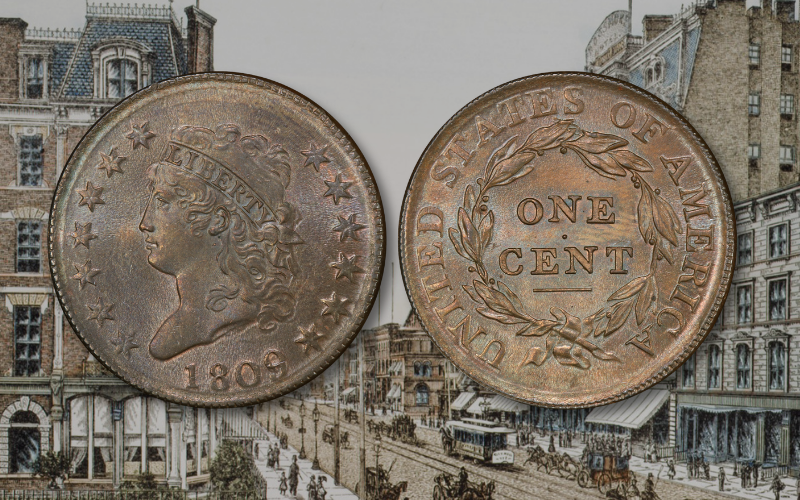
Large Cent (1793–1857)
The Large Cent was one of the first coins struck by the U.S. Mint for general circulation, introduced in 1793 and produced through 1857, with only brief interruptions. Across its long production run, the design evolved through several distinct types, from the early Flowing Hair and Liberty Cap varieties to the Draped Bust, Classic Head, Matron Head (Coronet Head), and Braided Hair designs. Each type reflects the artistic preferences, engraving techniques, and technological advances of its era.
For collectors, the Large Cent series provides a remarkable chronicle of early American numismatic development, with key dates, scarce varieties, and historical connections that reward careful study. Explore Pinehurst Coins’ selection of early American and rare coins to discover available examples.
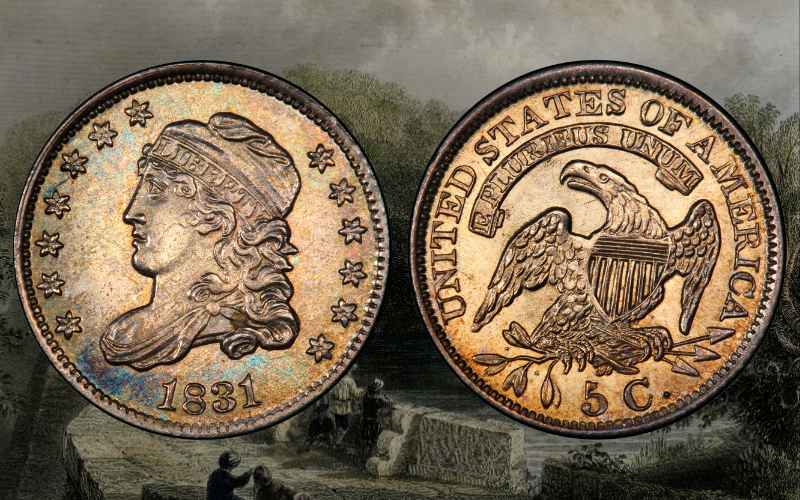
Capped Bust (1809–1839)
Designed by John Reich, the Capped Bust series appeared across the half dollar, quarter, dime, and half dime during a period when American coinage was becoming more standardized and refined. Liberty appears wearing a cloth cap, a classical symbol of freedom, while the reverse features an American eagle.
The series represents an important transition between the early experimental years of the U.S. Mint and the more advanced manufacturing techniques that would emerge during the 19th century. As coin production became increasingly mechanized, designs like the Capped Bust series reflected the growing maturity of American numismatics.
Capped Bust half dollars remain a perennial favorite among early American type collectors thanks to their large format, classic designs, and the wide variety of dates and die varieties available.
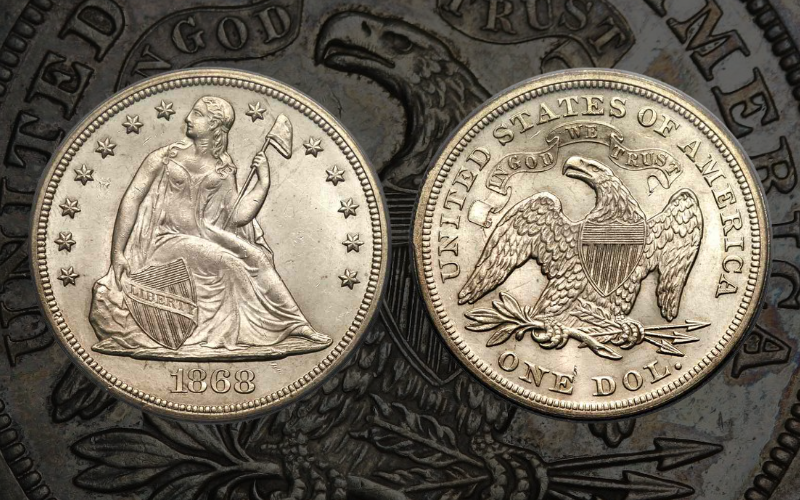
Seated Liberty (1836–1891)
Christian Gobrecht’s Seated Liberty design—Liberty seated on a rock, holding a shield and a pole topped with a Liberty cap—became the dominant American coinage motif from the late Industrial Revolution through the Civil War era and beyond. First appearing on the Gobrecht dollar in 1836 and then expanding across regular coinage, the design was featured on nearly every major U.S. silver denomination, from the half dime to the dollar.
The introduction of Seated Liberty coins coincided with the Philadelphia Mint’s transition to steam-powered presses and increasingly industrialized production methods. The series represents an important step in the evolution of American coinage, reflecting the same broader technological transformation that had reshaped minting in Britain and Europe decades earlier.
Understanding what makes a coin numismatic is especially relevant here: Seated Liberty coins span more than five decades and include numerous dates, mint marks, varieties, and condition rarities. For collectors, factors such as date, mint mark, strike quality, and preservation combine to create a wide range of values and collecting opportunities.
Frequently Asked Questions About Industrial Revolution Coinage
Why is the Cartwheel Twopence so much rarer than the Penny?
The Twopence proved impractical for everyday use; weighing two ounces of copper, it was simply too large and heavy for many transactions. As a result, demand was limited, and far fewer were produced: approximately 720,000 Twopences compared with roughly 45 million Pennies in 1797. Many Twopences were later melted when copper values increased, further reducing the surviving population.
Today, the combination of low mintage, heavy production standards, and historical importance makes the Cartwheel Twopence the key rarity of the series and a highly desirable coin among collectors of British industrial-era coinage.
What was the significance of the Soho Mint?
Matthew Boulton’s Soho Mint in Birmingham was one of the world’s first purpose-built industrial mints, introducing steam-powered presses and advanced manufacturing techniques to coin production. Its machinery allowed coins to be struck with a level of consistency, speed, and security that represented a major leap beyond earlier hand-operated methods.
The Soho Mint pioneered innovations such as standardized production, improved striking quality, and anti-counterfeiting features that influenced the future of modern minting. Boulton’s achievements helped inspire the modernization of the Royal Mint and shaped the development of industrial coin production worldwide.
Is the Seated Liberty series difficult to collect?
It can be, in the best way. The Seated Liberty design appeared from 1836 to 1891, beginning with the Gobrecht dollar and expanding across multiple U.S. silver denominations, including the half dime, dime, quarter, half dollar, and dollar. The series includes numerous subtypes, mint marks, and varieties, giving collectors many different ways to approach the set.
Collectors can focus on a single denomination by date and mint mark, build a complete type collection, or pursue specific rarities and varieties. Entry-level Seated Liberty coins can be accessible to many collectors, while key dates, scarce issues, and high-grade examples can become significant challenges requiring patience and research.
Explore Industrial Era Coins at Pinehurst Coins
From Boulton’s steam-powered Cartwheels to Gobrecht’s elegant Seated Liberty design, the coinage of the Industrial Revolution captures a world being transformed by technology, innovation, and ambition. Whether you’re drawn to the massive copper coins that pioneered industrial minting or the evolving designs of early American coinage, Pinehurst Coins offers a curated selection of world and U.S. coins for collectors to explore.
Browse our rare coins inventory to discover pieces from this remarkable era, and stay tuned for Part 5 of our History Through Coins series as we continue following the evolution of coinage through history.