

When the first English settlers arrived on American shores in the early 1600s, they brought with them something more pressing than ambition: a desperate need for money. The British Crown minted no official coinage for its American colonies, leaving settlers to barter with tobacco, corn, and whatever foreign coins came through trade. Part 5 of our History Through Coins series enters this monetary wilderness, a fascinating patchwork of Spanish silver, colonial copper, revolutionary tokens, and the first faint outlines of an American currency, to explore what money looked like in the decades that built a nation.
A Colony Without a Mint
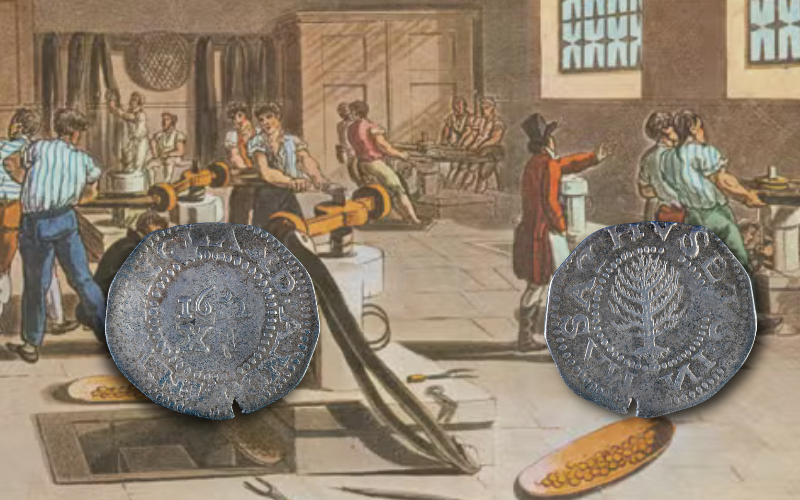
For most of the colonial period, British America had no official mint and no standardized currency. Colonists traded in whatever was available: British pounds when they could get them, commodity money (tobacco was legal tender in Virginia as early as 1619), and an ever-shifting mix of foreign coins from Spanish, Dutch, French, and Portuguese trade routes. The shortage was chronic, and the confusion was constant; the same coin could have different legal values in different colonies. Massachusetts briefly struck its own silver coins (the famous Pine Tree Shilling, 1652–1682), technically illegally under British law, but most colonists had no such option. Into that gap stepped one coin above all others.
The Coins of Colonial and Revolutionary America
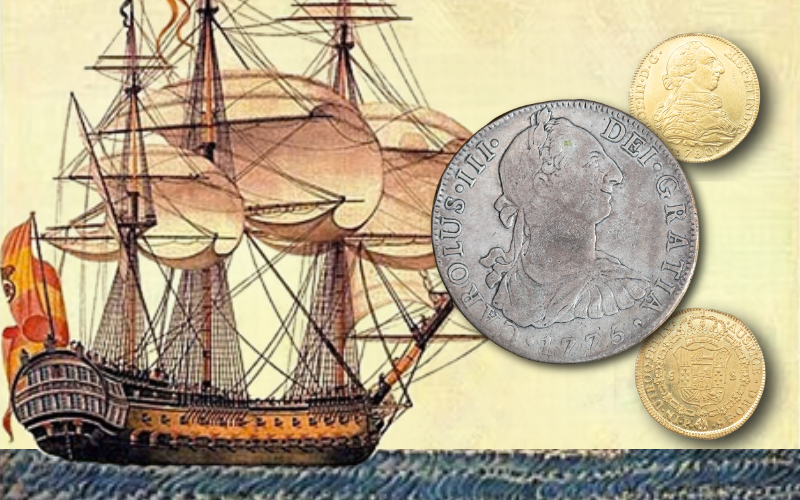
Spanish Piece of Eight (8 Reales)
As we explored in Part 3 of this series, the Spanish 8 Reales, or the piece of eight, was already the dominant global trade currency before the colonies existed. In America, it filled the void that British monetary neglect created. Spanish milled dollars poured in through West Indies trade routes and became so fundamental to colonial commerce that Congress pegged the first U.S. dollar directly to their value. They remained legal tender in the United States until 1857. Colonists physically cut them into eight “bits” for smaller transactions, the origin of “two bits” as slang for a quarter that survives to this day.
Colonial Halfpennies & Pennies
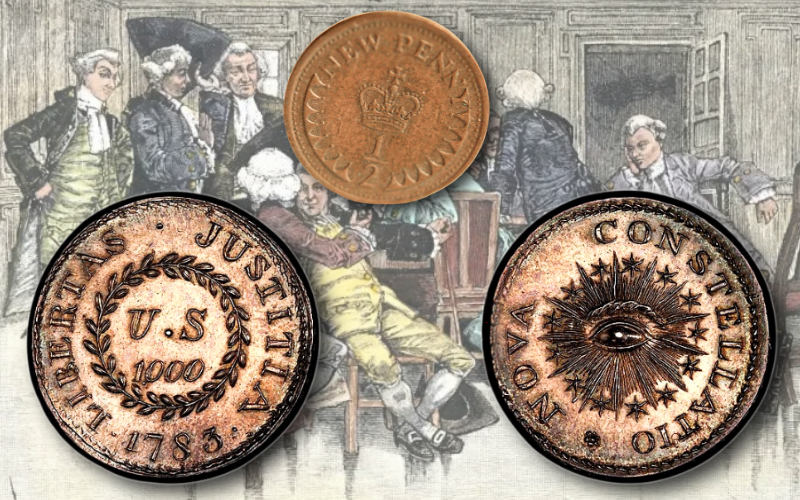
With silver scarce and copper coinage in short supply, colonists—and later the newly independent states—relied on a mixture of British copper coins, locally authorized issues, and private tokens for everyday transactions. These pieces form one of the most varied and historically rich collecting fields in American numismatics:
- British regal halfpennies circulated widely, often becoming worn smooth after decades of use.
- State-issued coppers emerged during the 1780s as individual states experimented with producing their own coinage. Connecticut, New Jersey, Vermont, and Massachusetts all struck copper pieces between 1785 and 1788, featuring distinctive designs and varying levels of workmanship.
- Private tokens filled many of the remaining gaps. Issued by merchants, businesses, and individuals, these pieces were accepted locally out of necessity and custom rather than as officially authorized national currency.
Continental Currency Coins & Tokens (1776)
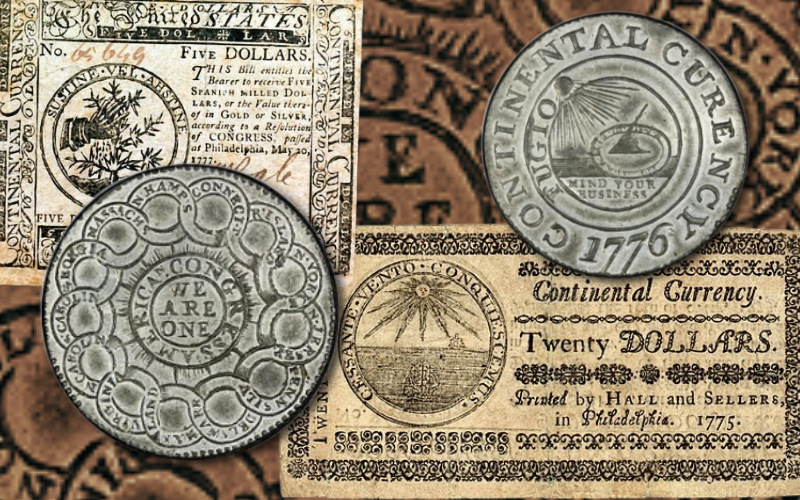
When the Continental Congress needed to fund the Revolution, it lacked both the resources to maintain a reliable supply of precious-metal coinage and a national mint. The result was Continental Currency, paper money denominated in dollars and initially tied to the value of the Spanish milled dollar. As Congress issued more notes to finance the war, the currency depreciated dramatically, giving rise to the expression “not worth a Continental.”
A small number of Continental Dollar pieces were also produced in 1776 in pewter, brass, and silver as proposed patterns for a national coinage. They were never issued for circulation, making them among the most historically significant patterns in early American numismatics. Their design, featuring a sundial, the Latin motto FUGIO (“I fly”), and the phrase MIND YOUR BUSINESS, has long been associated with Benjamin Franklin. Eleven years later, the same imagery and motto would appear on the Fugio Cent, the first coin authorized by the United States under the Articles of Confederation.
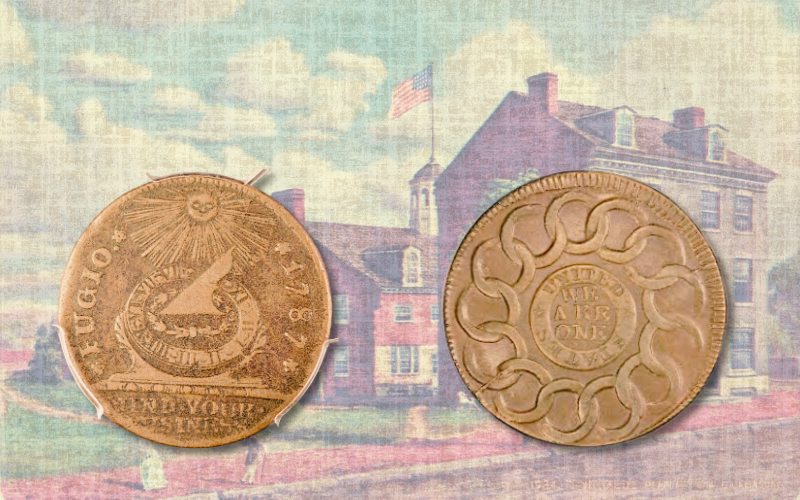
The Fugio Cent (1787)
The Fugio Cent represents the transition from colonial monetary chaos to the emerging financial system of the United States. Authorized by the Congress of the Confederation in 1787, it was the first regular-issue coin authorized by the national government. The design featured a Franklin-inspired sundial with the Latin word FUGIO (“I fly”) and the phrase MIND YOUR BUSINESS on the obverse. The reverse displayed thirteen linked circles representing the original states, surrounding the words WE ARE ONE—a powerful statement of national unity in miniature.
- Mintage: Approximately 400,000 pieces were authorized and struck under a federal contract with James Jarvis, a Connecticut coinage contractor.
- Circulation: The coins were intended for general circulation, but production problems resulted in many pieces being underweight and poorly struck. Their acceptance in commerce was limited, and the remaining coins were eventually disposed of through private channels.
- Collector significance: The Fugio Cent is one of the most historically important coins of early American numismatics. It connects directly to the founding of the republic and serves as an important introduction to colonial and early federal coinage. Understanding what makes a coin numismatic — including rarity, condition, and historical significance — is especially important when collecting Fugio Cents, as examples vary widely in quality, and authenticity concerns exist.
Frequently Asked Questions About Colonial & Revolutionary Coinage
Was any coin officially legal tender in all American colonies?
There was no unified currency across the colonies. Each colony set its own exchange rates for foreign coins, and the same Spanish piece of eight could have a different legal value in Massachusetts than in Virginia. This fragmentation was one of the motivating arguments for a national currency after independence.
What happened to Continental Currency after the Revolution?
Continental paper notes lost most of their value during the Revolutionary War as Congress issued currency faster than it could be supported by taxation or other financial resources. By the end of the war, the notes were effectively worthless, giving rise to the expression “not worth a Continental.”
The collapse of Continental Currency deeply influenced the nation’s founders and their approach to monetary policy. The new Constitution gave Congress authority to coin money while limiting the states’ ability to issue paper money or make anything other than gold and silver coin legal tender for debts. This experience helped establish a strong preference for a stable, metallic monetary standard in the early United States.
Are Fugio Cents rare or affordable for new collectors?
Fugio Cents are available to collectors across a range of budgets, although prices vary considerably by variety, condition, and authenticity. Lower-grade examples can sometimes be found through auctions and established dealers, while higher-grade coins with sharp details and attractive surfaces command substantial premiums. Because counterfeits and altered examples exist, collectors considering a significant purchase should consider professionally authenticated examples from services such as PCGS or NGC.
Explore Colonial & Early American Coins at Pinehurst Coins
The coins of Colonial and Revolutionary America tell the story of a nation improvising its way to financial independence. Whether you’re drawn to the global reach of the Spanish piece of eight, the founding symbolism of the Fugio Cent, or the variety of state copper coinage, Pinehurst Coins carries a curated selection of rare and early American coins to explore. Stay tuned for Part 6 of our History Through Coins series.