

Dating ancient coins requires meticulous analysis, as they often lack explicit dates found on modern currency. Numismatists employ various methods to determine a coin’s age, including examining inscriptions, iconography, and historical context.
Inscriptions and Iconography

Ancient coins frequently feature inscriptions and symbols referencing rulers, deities, or significant events. By examining these elements, experts can associate a coin with a specific time period or authority. For instance, coins minted during the Roman Republic may depict Julius Caesar with the title “dictator for life,” indicating issuance shortly before his assassination in 44 B.C.
Historical Context

Understanding the historical and political climate during which a coin was produced aids in dating. Changes in leadership, significant events, and shifts in artistic styles provide context that helps narrow down production dates. For example, after Caesar’s death, coins bearing Brutus’s image and symbols denoting the defeat of tyranny were circulated, reflecting the political transition.
Archaeological Evidence
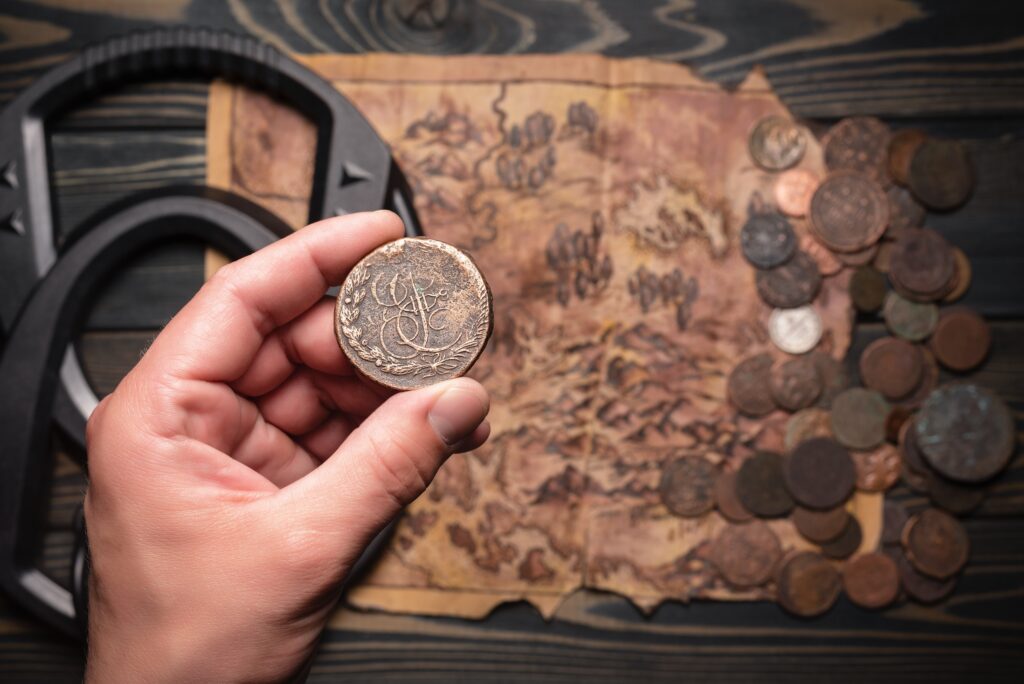
The location of a coin’s discovery and its association with other artifacts offer valuable dating information. Coins unearthed in specific archaeological layers can be correlated with known historical timelines, assisting in establishing a more precise age.
Dating Systems in Ancient Coins
In the Hellenistic period, dating coins became more systematic, especially in the eastern Greek world. Coins were often dated based on the reigning monarch’s regnal year or the founding of a city. For example, the Seleucid Empire used an era starting from 312 B.C., the year Seleucus I captured Babylon. Coins from this era might bear dates corresponding to this starting point, requiring conversion to modern calendar years.
Additionally, different cultures employed various numeral systems. While many modern coins use Arabic numerals, ancient coins might feature Greek letters representing numbers. For instance, the Greek letter ‘A’ stood for 1, ‘B’ for 2, and so on. Understanding these systems is crucial for accurately dating and interpreting ancient coinage.
Through these combined approaches, numismatists piece together the chronological puzzle of ancient coinage, providing insights into the economic, political, and cultural landscapes of past civilizations.